
- Home
- On this day in Wembury
- 06-23
ChatGPT said:
On This Day in Wembury — 23 June 1887
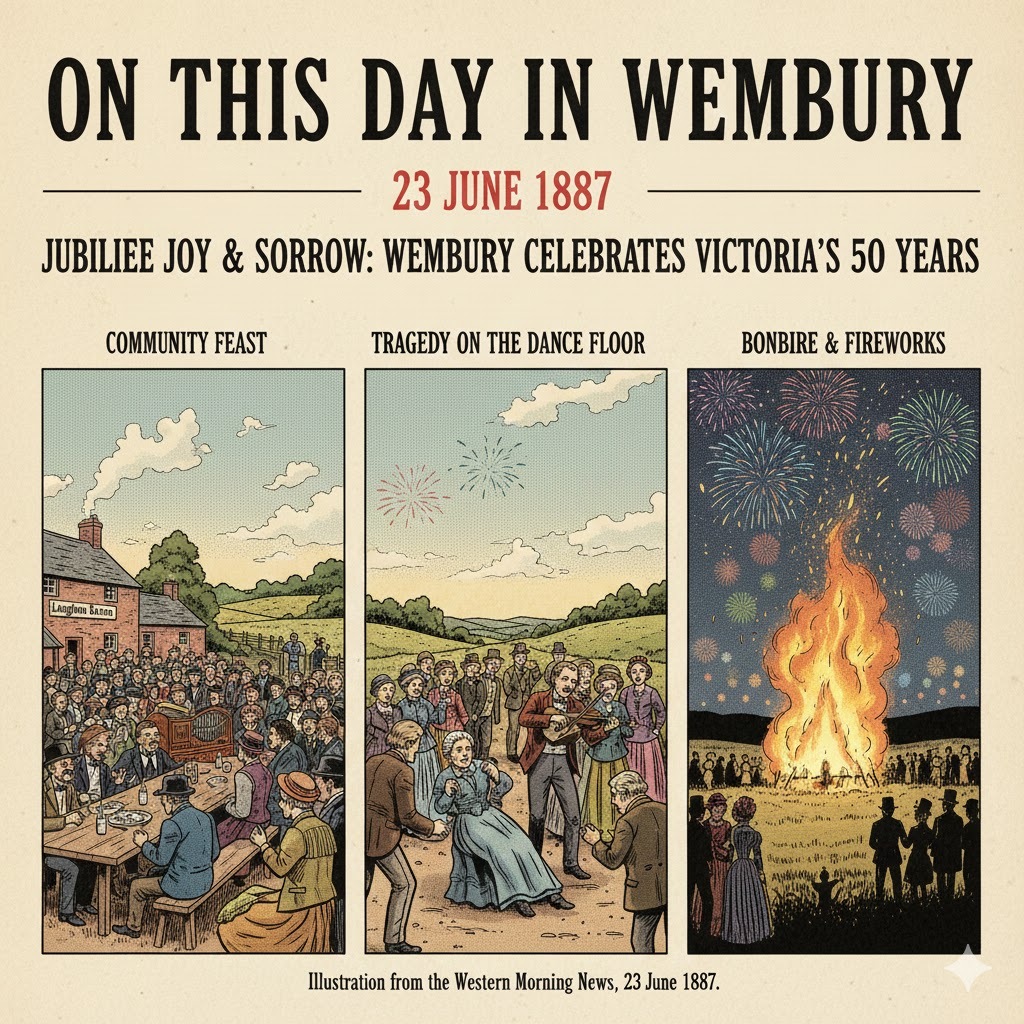
The Golden Jubilee of Queen Victoria was marked in Wembury with great celebration. Through the generosity of parish benefactors, the entire community was invited to gather in a field adjoining Langdon Barton after 3 o’clock. The Rev. O. Burgess led divine service, prayers were read, and an American organ accompanied the singing. Afterwards, all were treated to a sumptuous communal meal, followed by sports, dancing, and music from fiddles, concertinas, and even tin whistles.
But the day was struck by tragedy. Mrs. Avery, wife of Samuel Avery of Down Thomas, collapsed suddenly while dancing with her son. Despite immediate efforts from bystanders, she could not be revived; medical aid confirmed her death was caused by heart disease. The unexpected loss cast a shadow over the festivities, and many left the field in sorrow.
Later that evening, the jubilee spirit returned as a great bonfire was lit on Traine Hill at 10 o’clock, with fireworks sent skyward. From there, forty-five bonfires could be seen blazing across the region in a remarkable display of loyalty and celebration.
Reflection:
This event encapsulates the blend of joy and fragility that so often characterises village life. The Jubilee brought together all classes of Wembury society in a rare collective feast, but the sudden death of Mrs. Avery turned jubilation into mourning. Yet, as the night sky lit with bonfires from Traine Hill to distant parishes, the parish’s grief became part of a wider moment of national celebration—reminding us that Wembury’s local stories are always intertwined with the larger sweep of history.
Source: Western Morning News, 23 June 1887.
On this day in Wembury — 23 June 1932
The Western Morning News carried a strongly worded letter about the unchecked growth of makeshift housing on the West Wembury estate. The writer complained that there appeared to be no effective control over the type of new buildings going up on the cliff lands: converted motor buses, railway coaches, and wooden huts were already being used as living quarters, with no adequate water supply or drainage.
The letter warned that if the estate were “skillfully planned and properly developed” it could form a harmonious extension of the old village, a quiet resort for Plymouth workers. But if left to haphazard growth, it risked becoming another Whitsand Bay, where shacks and bungalows had spread without planning. The coastline from the Yealm to Heybrook Bay was still prized for its quiet charm and rural character, and the writer urged the local authority to act quickly—controlling future building, and ideally preserving the clifflands as open space overlooking Wembury Bay.
In making the case, the correspondent compared Wembury to Clovelly in North Devon, which had retained its fame as one of Britain’s most picturesque villages thanks to careful preservation by its landowner. Without similar effort at Wembury, they feared the coast could be scarred by speculative development and the exploitation of natural beauty for commercial ends.
(Source: Western Morning News, 23 June 1932)
Entries are summaries and interpretations of historical newspaper reports.