On this day in Wembury — 16 June 1938


A fascinating report in the Western Morning News describes a full day of historical exploration in Wembury by the Plymouth and District branch of the Devonshire Association. Their visit gives us a rare glimpse of Wembury’s heritage as it appeared just before the Second World War.

The group first toured the seventeenth century almshouses beside Wembury House. One cottage was empty, allowing the visitors to step inside and admire the tiny chapel built into the range. They examined the curious plaster relief placed over the small altar, showing fleurs de lis and three human figures. Two appeared to be making burnt offerings, while the third had been mutilated. Most of the party interpreted the scene as Cain and Abel, with the fleurs de lis symbolising the Trinity.

Mrs C Walker of Wembury House acted as their guide and gave a clear history of the estate. The original house belonged to the Prior and Convent of Plympton, then passed through the hands of the Earls of Southampton, the Chamberlaynes, the Heales, Sir Edward Hungerford, the Duke of Albemarle, the Polexfens, Francis Chudleigh, William Molesworth and finally William Lockyer. Lockyer demolished the old fortified house around 1802 to 1803 and built the present Wembury House, incorporating fragments of earlier stonework. As the group walked the gardens, they spotted many pieces of carved stone reused in rockeries and walls. The tall, buttressed boundary wall still survives from the earlier, fortified structure, complete with a walkway and steps leading to a small elevated “surprise garden”.

After tea the party moved to St Werburgh’s Church, where the vicar, Rev C ff Young, welcomed them and spoke about its history. He noted that although the main fabric dated to the fourteenth or fifteenth century, some parts were older still. The group examined the great Hele monument filling the north chancel wall, showing Sir John Hele, his wife and their large family. Rev Young also retold the gentle and humorous legend of St Werburgh and the geese, in which the saint rebukes a flock for eating cabbages, only to discover they had done so in protest after the cook made two of them into a pie. When she prayed over the pie the geese were restored to life. Her motto, he said, was “To live and let live”.

The visit ended with thanks from J J Beckerlegge, the Devonshire Association’s honorary secretary.

This 1938 account is one of the richest descriptive pieces ever printed about Wembury House, the almshouses and the church, and it remains a valuable window into the village’s heritage just before wartime upheaval changed so much of Devon life.


On this day in Wembury — 16 June 1942

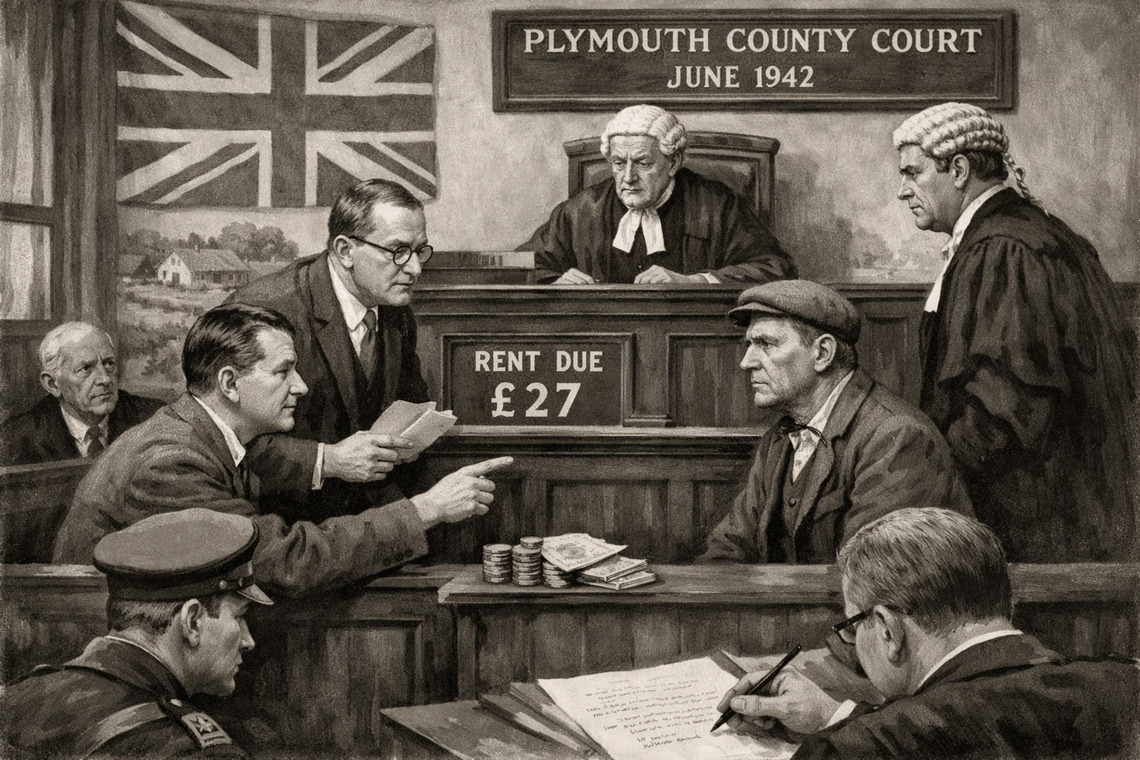
The Western Morning News (17 June 1942) reported a case at Plymouth County Court concerning farmland at Knighton, Wembury.

John Albert Edward Camp, a motor engineer of 15 Garden Crescent, West Hoe, Plymouth, brought a claim for £27 in respect of one year’s rental of fields at Knighton, plus costs, against Maurice Sherwill, farmer of Knighton Farm, Wembury. His Honour Judge Scobell Armstrong allowed the claim. Mr. D.L. Roseman represented the plaintiff, and Mr. J. Woolland the defendant.

This was a straightforward landlord–tenant rent dispute. Although Sherwill occupied and farmed Knighton Farm, some of the surrounding fields were evidently owned or leased out by Camp, who pursued the unpaid rent through the courts.

  • Sherwill appears several times in Wembury sources around this time, notably in 1939 when a disused Great War shell was found in his Knighton orchard.

  • The case underlines the mixed pattern of land tenure in Wembury, where farmers often rented parcels from different landlords, sometimes local, sometimes Plymouth-based.

  • The sum of £27, while modest, equated to around £1,500–£1,600 in today’s value, a meaningful debt during wartime rationing and agricultural pressure.

(Source: Western Morning News, 17 June 1942 — Plymouth County Court report.)