
🗓️ On This Day in Wembury — 10 June 1938
Yealm Coastline Safeguarded by Restrictive Covenant
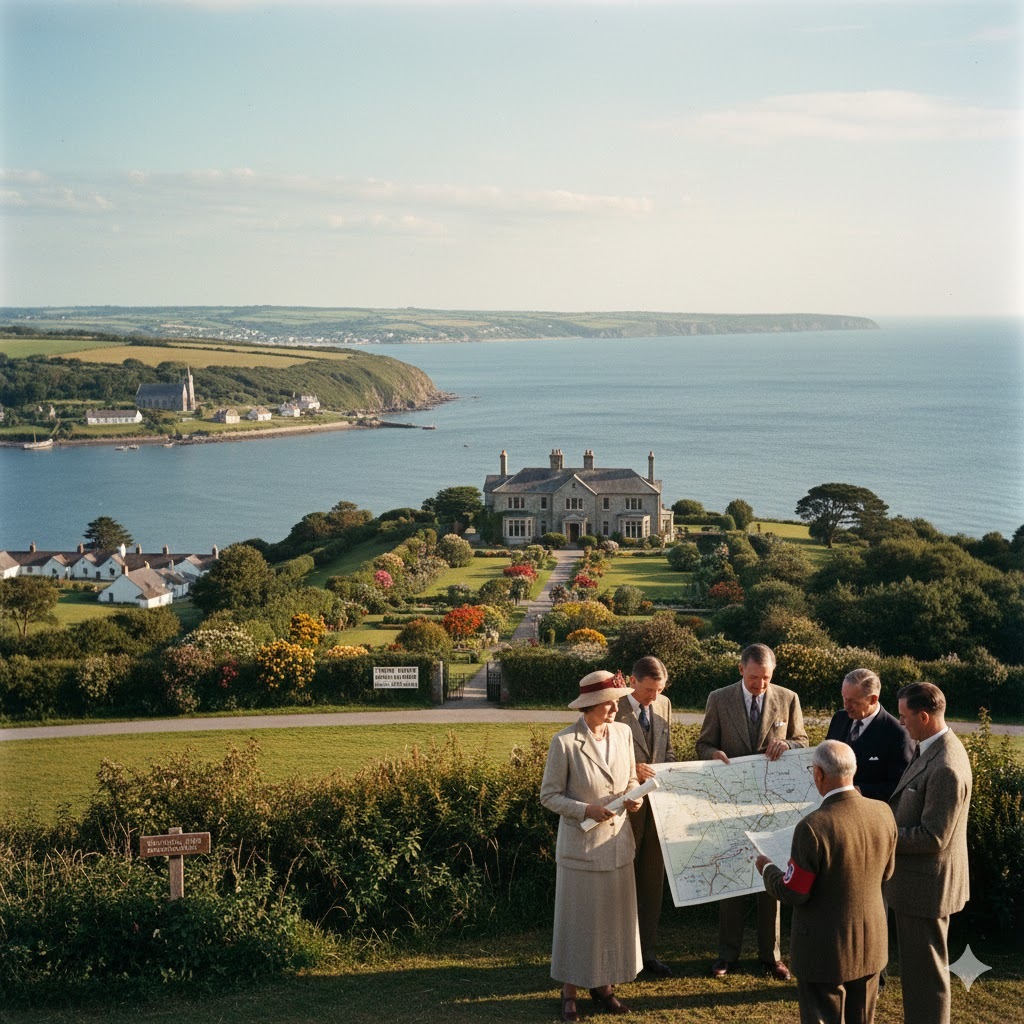
On this day, the Western Morning News reported that the Hon. Mrs. Sebag-Montefiore, owner of the Thorn Estate at Wembury, had secured the protection of the entire western bank and coastline of the River Yealm from Wembury Church to Wembury Wood, opposite Steer Point.
In selling Thorn, she reached an agreement with the purchaser to place restrictive covenants in favour of the National Trust, preventing spoliation of this remarkable landscape. The move was described as a complement to her earlier gift of coastal land to the Trust between Wembury and Thorn.
Thorn House itself, overlooking the Yealm, was famed for its gardens and shrubberies, but it was the estate’s setting along 124 acres of riverbank and coastline that made this agreement so significant. Alongside it, properties such as the coastguard cottages on the Yealm, Old Barton Farm, and Newton Wood were also marked for sale.
With this action, Mrs. Sebag-Montefiore ensured that one of Devon’s most beautiful river valleys would remain unspoiled. Seen in sequence — her 1935 gift of Yealm cliffs to the National Trust, her opening of Thorn’s gardens for charity in 1938, and now this protective covenant — her legacy at Wembury is that of a landowner who looked beyond private ownership to the long-term public good.
📖 Source: Western Morning News, 10 June 1938
On This Day in Wembury — 10 June 1939
At Langdon Court, the community gathered for a lively fete in aid of the proposed new Wembury Social Hall. The star of the day was Simon, a ten-year-old Old English sheepdog owned by Mrs. E. W. Hardy, who charmed the crowds by collecting donations with a box strapped to his back. Together with stalls, sideshows, and displays, Simon’s efforts helped raise £90 toward the project — bringing the fund to £220 of the £1,400 target.
Lady Evelyn Patrick, wife of the M.P. for Tavistock Division, formally opened the event. Visitors enjoyed Bluejacket Band music, field gun drills, hornpipe dancing, a variety show, and even “pirates’ caves” tours beneath Langdon Court’s cellars. Local families, naval personnel, and school groups all lent their support, turning the day into a memorable show of community spirit.
Source: Western Morning News, 12 June 1939
The old village hall was already described as “dilapidated” in 1939. That the community still came together in such force on the eve of war shows how deeply Wembury valued having a place to gather — a reminder of how village halls often served as both social hubs and symbols of resilience.
Entries are summaries and interpretations of historical newspaper reports.