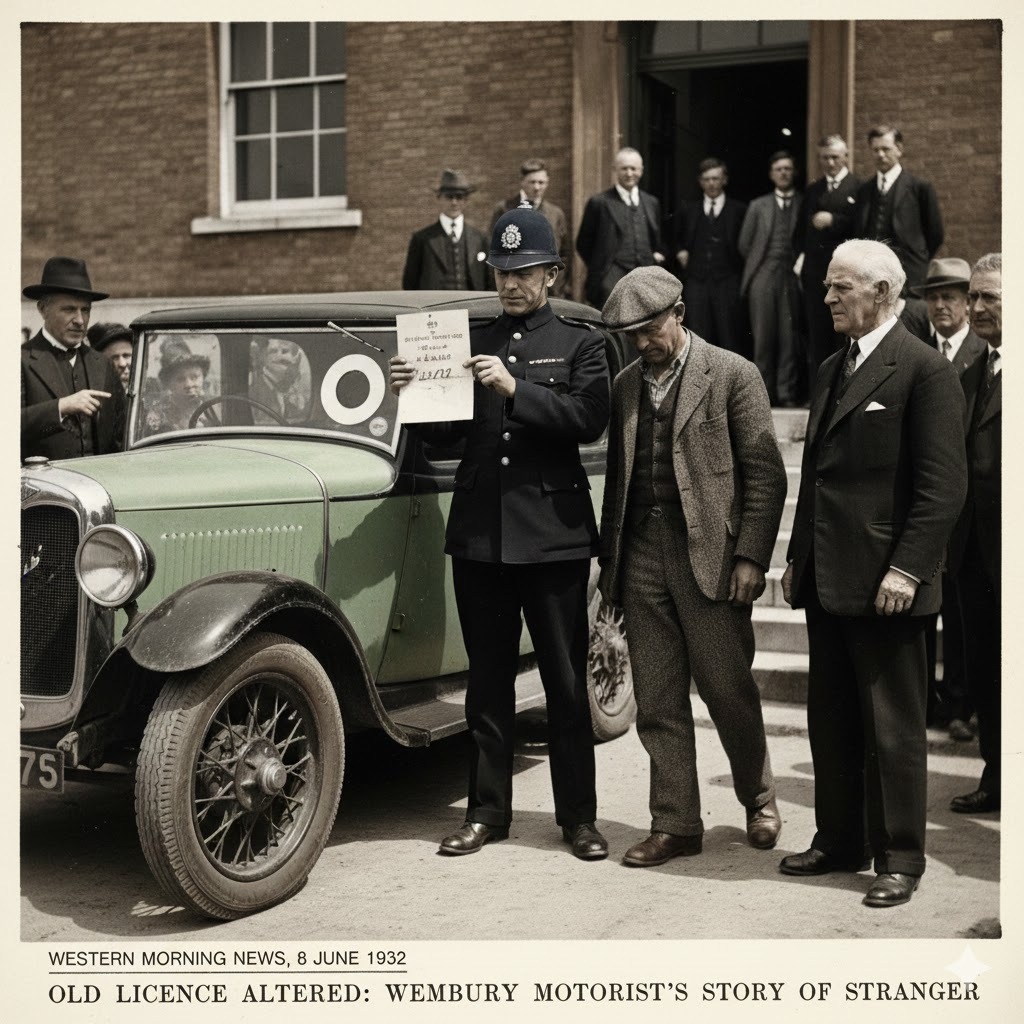
On this day in Wembury — 8 June 1932

The Western Morning News reported an unusual case from Yealmpton Police Court involving Albert Willingham of Wembury, who faced three charges: using a motor-car without a Road Fund licence, making a false declaration on a licence application, and fraudulently using an altered licence.

Willingham pleaded guilty. Superintendent Smith told the court that Constable Martin had stopped the defendant at Brixton on 26 February and discovered that his motor licence—expired on 30 December 1930—had been altered to show a new expiry date of 24 March 1932. The alteration, he explained, was easy to miss because the licences for those quarters were printed in similar colours.

Willingham claimed that while in Kingsbridge that January, a stranger had offered to “fix” his licence for him, and he had foolishly agreed. The second offence, the false declaration, arose because he had signed a new licence application form stating that the car had not been used since the previous licence expired—though he admitted driving it in both January and February.

The magistrates imposed fines on each of the first two summonses and a separate penalty for the fraudulent use of the altered licence.

Context

At this time, the Road Fund licence (the forerunner of today’s vehicle excise duty disc) had to be displayed on a car’s windscreen and was issued quarterly in different colours. Forgery or alteration was treated seriously, as it deprived the Road Fund of revenue used for highway maintenance. The case gives a small glimpse into early motoring life in rural South Devon, where village drivers like Willingham were still adjusting to the growing web of motoring laws and paperwork that came with the expanding use of cars.

(Source: Western Morning News, 8 June 1932 — “Old Licence Altered: Wembury Motorist’s Story of Stranger.”)

06-08.jpg


Curated and written by Wembury Waves using material from the British Newspaper Archive.
Entries are summaries and interpretations of historical newspaper reports.