
On This Day in Wembury – 28 April 1928
Roman coins discovered at Heybrook Bay
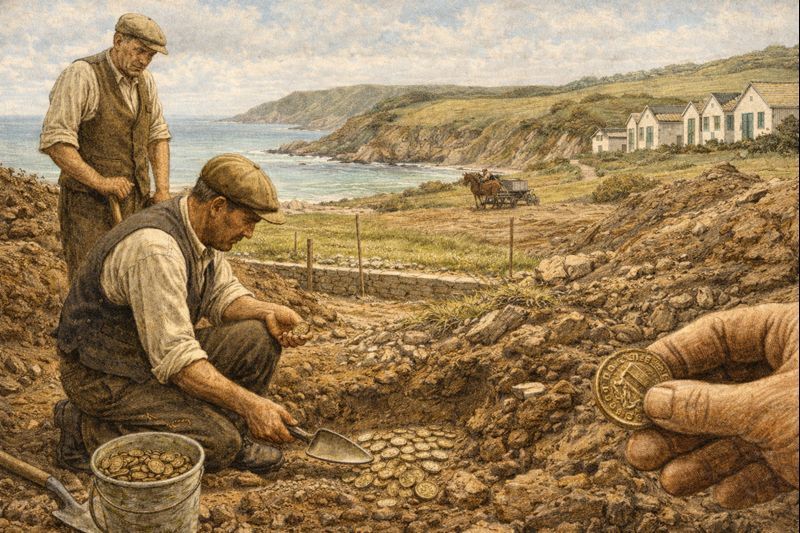
On this day the Western Morning News reported that during excavations for bungalow foundations near Heybrook Bay, Wembury, workers unearthed about 50 coins at a depth of roughly four feet. They were found close to signs of ancient foundations. The coins were believed to be of Roman origin, though their precise date and type were not immediately confirmed.
The find suggested that this part of the Wembury coastline had once been a site of human settlement or activity long before modern houses were built there.
The coins at Heybrook Bay placed Wembury within the wider pattern of Roman presence across South Devon. Roman roads, villas, and farmsteads are recorded in the South Hams, with pottery, coins, and building traces turning up at scattered sites from Plympton to Modbury. The Yealm estuary itself, with its sheltered access to the sea, would have been a natural point of contact. These 1928 finds remind us that the cliff-top paths and coves we walk today were once part of Rome’s western frontier, leaving small but enduring clues of an empire that stretched even to Wembury’s shores.
Source: Western Morning News, 28 April 1928.
Entries are summaries and interpretations of historical newspaper reports.